
Bear Detection Device: A smart solution from SMK Abdul Rahman Talib students tackles the conflict between Sun Bears and Kelulut Honey Farms
KUANTAN, 30 June 2025 – Nestled within the beautiful surroundings of the Pahang National Park lies a pressing challenge faced by kelulut honey entrepreneurs—the recurring threat of Sun Bear attacks.
This persistent problem has long troubled Ahmad Izzudin, the owner of Lior Farm, who has had to deal with the destruction of kelulut nests caused by wild animals each year.
The issue, however, recently drew much-needed attention when Teacher Nur Hidayati Othman, a Technology Design (RBT) teacher at Sekolah Menengah Kebangsaan Abdul Rahman Talib (SMART), and her students, Aina Batrisya Badli, A’isyah Faqihah Azrul, and Nursuziana Mohd Ali, developed an innovative solution called the Bear Detection Device.
The Bear Detection Device is a smart system that integrates image recognition technology, solar power, and real-time warning alerts to protect farms without harming wildlife.
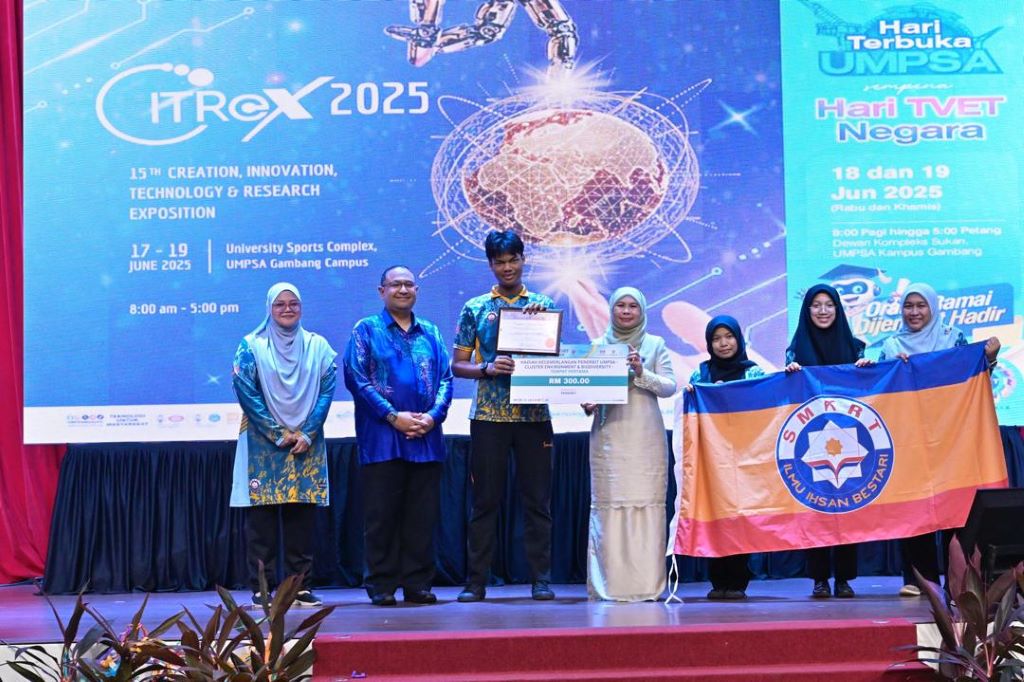
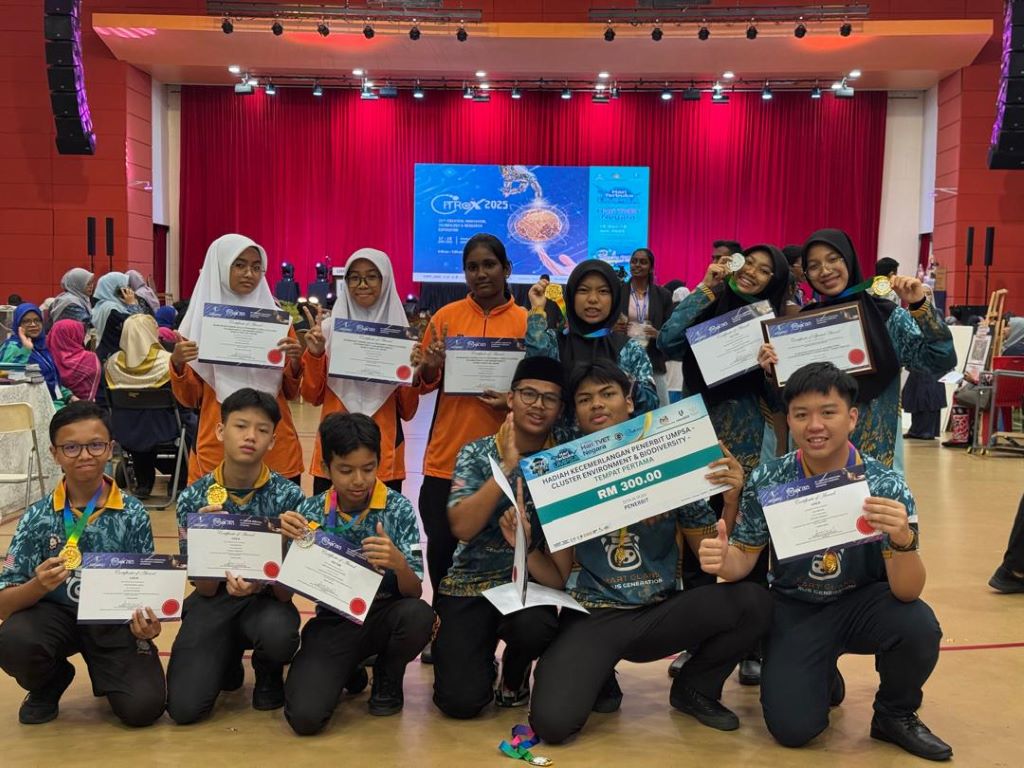
This invention received the UMPSA Publisher Excellence Award for the Environment and Biodiversity Cluster at the Creation, Innovation, Technology & Research Exposition (CITREX) held recently at Universiti Malaysia Pahang Al-Sultan Abdullah (UMPSA).
Teacher Hidayati shared that she was motivated to act after hearing firsthand about the challenges faced by Ahmad Izzudin.
“Each time a bear attack occurred, not only was the honey lost, but the farm workers became too afraid to continue their work,” she explained.
“That was the moment I knew I had to do something that could genuinely help.”
The project began in March 2024 and was completed within five months, by August 2024.
The Bear Detection Device is designed to operate around the clock. It uses solar-powered ESP32 cameras, which are installed around the farm area.
These cameras send footage to a laptop via Wi-Fi, where AI-based image recognition software known as YOLOv5 identifies the presence of bears.
According to Teacher Hidayati, technologies like YOLOv5 are typically used in the security industry or in self-driving vehicles.
“I thought to myself, why not use this same technology to protect farms?” she said.
Once the system detects a bear, it triggers three automatic responses.
A siren is activated to scare the bear away. A notification is sent to the owner’s and employees’ smartphones via the Blynk app.
Additionally, an LCD screen displays a live alert, pinpointing the bear’s location on the farm.
“The device is also designed to function in all weather conditions and is equipped with infrared LEDs to enable night-time detection,” she said.
To ensure durability, the cameras are encased in housings made from PLA (Polylactic Acid), a lightweight material that resists tropical humidity.
“I want to keep costs low so that small-scale farmers can afford the technology.
“It’s pointless to have advanced technology if it isn’t accessible to those who need it most,” she said.
With a material cost of only RM237 for two camera units, the system can be easily expanded by adding more cameras and network connections to suit larger farm sizes.
She also noted that the system does not rely on electric fences or chemical repellents, making it safer for both humans and animals.
“We don’t want to harm or kill the bears.
“We just want to protect our crops.
“That has been my principle from the beginning,” she said.
This innovation has not only proven useful to entrepreneurs like Ahmad Izzudin but has also earned numerous recognitions.
These include a Gold Award at the Chumbaka Young Innovators Challenge 2024 organised by UMPSA, Champion title at Koi Innovate 2024, a Silver Award at the TM Future Skills Tech Titan Challenge 2024, and another Silver Award at the Intellectual Property & Innovation Exposition (IPITEx) 2025.
“The awards are a bonus.
“What matters most is seeing how such a small invention can have a big impact on someone who truly needs it.
“That is the real satisfaction,” she said.
The device has been registered with the Intellectual Property Corporation of Malaysia (MyIPO) for copyright protection as a first step toward commercialisation.
Teacher Hidayati is currently working to strengthen collaborations with conservation agencies and government departments, such as the Department of Wildlife and National Parks (PERHILITAN), to expand the use of this system in other areas affected by human-wildlife conflict.
She believes that if the system can benefit kelulut honey farms, it can also be used to protect vegetable and fruit farms near forested areas.
“In fact, it could one day become an official tool for wildlife monitoring,” she added.
The Bear Detection Device is just one of several innovations that Teacher Hidayati has developed. In the past, she created the I-SMART Power Window Safety System, which detects carbon monoxide in vehicles, and the Universal Mobilizer, a mobility aid for disabled individuals equipped with an IoT safety system.
As an educator, she believes that knowledge should not be limited to examinations.
“It should be used to solve real-life problems.
“When students see their teacher invent something useful for the community, it becomes a powerful source of inspiration.
“The Bear Detection Device proves that innovation doesn’t have to come from a university lab or a large tech company,” she said.
She added, sometimes, it comes from a teacher who listens to the community and uses knowledge to create meaningful solutions.
What started as a simple initiative at a regular school in Kuantan has now become a powerful example of how a small innovation can make a big difference in protecting farms, supporting the environment, and promoting a more sustainable future.
By: Naqiah Puaad, Centre for Corporate Communications
Translation by: Aminatul Nor Mohamed Said, UMPSA Career Centre (UMPSACC)
- 105 views