
UMPSA leads AEROGROUND research to develop Autonomous Aero-Ground System for national resilience
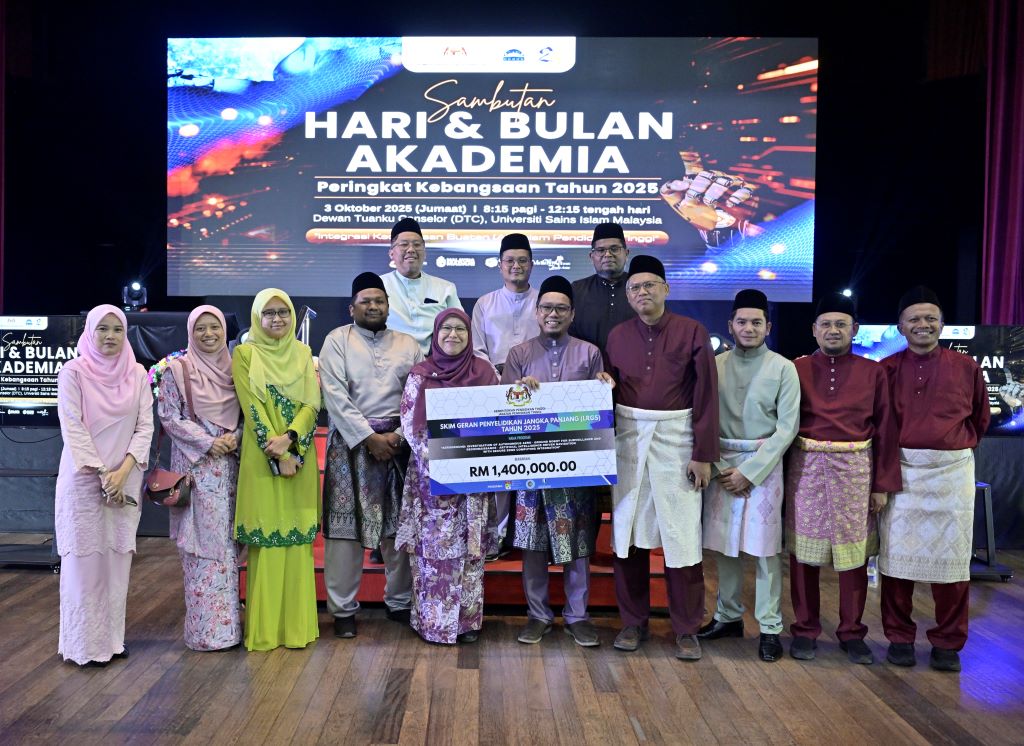
PEKAN, 6 October 2025 – Director of the Centre for Innovation and Technology Transfer and Principal Research Fellow at the Advanced Industrial Technology Centre, Associate Professor Ts. Dr. Muhammad Aizzat Zakaria from Universiti Malaysia Pahang Al-Sultan Abdullah (UMPSA), successfully secured the 2025 Long-Term Research Grant Scheme (LRGS) from the Ministry of Higher Education (MOHE) worth RM1.4 million to lead a high-impact research project entitled ‘AEROGROUND: Investigation of Autonomous Aero-Ground Robot for Surveillance and Reconnaissance – Artificial Intelligence Driven Navigation with Secure Edge Computing Integration’.
This research focuses on the development of an integrated autonomous land and aerial robotic system for monitoring, tracking, and response purposes towards national security threats.
The project is implemented under the theme ‘National Resilience to Security Threats’, in line with the research scope of the Ministry of Higher Education (MOHE), which focuses on sovereignty issues and the development of new technologies such as AI, autonomous systems, IoT, and smart automation.
According to Associate Professor Ts. Dr. Muhammad Aizzat, who is also the AEROGROUND Programme Leader, this initiative is a strategic collaboration between three universities, namely UMPSA, Universiti Pertahanan Nasional Malaysia (UPNM), and Universiti Kebangsaan Malaysia (UKM).
“It will combine multidisciplinary expertise in control engineering, unmanned systems, and digital security.
“AEROGROUND is developed to address current challenges in border surveillance and defence operations that still rely heavily on manual control.
“We aim to produce an aero-ground system capable of operating autonomously, making its own decisions, and providing real-time situational awareness to security forces,” he explained.
He further added that this project is developed through three main components, each with a different area of specialisation in the respective universities.
“The project led by UMPSA focuses on the development of an autonomous ground robot platform equipped with a multi-sensor fusion system that integrates data from multiple sources to enhance navigation and environmental perception capabilities.
“This research also emphasises resilience against system errors and the improvement of real-time positioning accuracy using Artificial Intelligence-based mapping and tracking algorithms (AI-based SLAM),” he said.
The UMPSA research team is also supported by several UMPSA lecturers, namely Senior Director of the Research Excellence Management Centre, Professor Ts. Dr. Adam Abdullah, as well as lecturers from the Faculty of Manufacturing and Mechatronic Engineering Technology (FTKPM), Associate Professor Ir. Ts. Dr. Faiz Mohd Turan, Dr. Ismayuzri Ishak, Ts. Dr. Mohamad Heerwan Peeie, and Dr. Muhammad Izhar Ishak.
Associate Professor Ts. Dr. Muhammad Aizzat also mentioned that UPNM, led by Col. Professor Dr. Khairol Amali Ahmad, focuses on the development of an intelligent control system based on Model Predictive Control (MPC) to enhance stability and target-tracking accuracy in autonomous mobile platforms.
“This research emphasises the system’s ability to maintain control and high sensitivity to targets even under high-intensity operational conditions or during external disturbances.
“It serves as a crucial component in ensuring the efficiency of smart weapons systems and unmanned defence equipment.
“The UPNM research team consists of Ts. Dr. Noor Hafizah Amer, Dr. Zulkiffli Abd Kadir, Associate Professor Dr. Leong Kin Yuen, Ts. Dr. Nurul Atiqah Othman, Dr. A'qilah Ahmad Dahalan, and Ts. Sr. Gs. Wan Mohamed Syafuan Wan Mohamed Sabri,” he said.
In addition, he added that for the third component, the UKM research team, led by Associate Professor Ir. Dr. Rizauddin Ramli focuses on the development of an integration system between unmanned aerial vehicles (UAV) and autonomous ground vehicles (AGV).
“This system is developed based on artificial intelligence for the coordination of automatic surveillance and tracking operations.
“The drone, functioning as the aerial unit, will act as a scout to expand area coverage, improve detection accuracy, and coordinate response actions between the aerial and ground platforms.
“The UKM team includes Associate Professor Dr. Mohamad Hanif Md Saad, Dr. Mohd Faisal Ibrahim, Dr. Mohd Hairi Mohd Zaman, Dr. Mohamad Hazwan Mohd Ghazali, and Ir. Dr. Mohd Sabirin Rahmat,” he said.
The development of AEROGROUND will serve as the foundation for the next generation of the nation’s autonomous defence systems, which will not only enhance operational security efficiency but also strengthen local research capabilities in robotics, artificial intelligence, and edge computing.
He hopes that the success of this project will take Malaysia a step further in modern defence technology and support the agenda of MOHE and the government in building national resilience against future threats.
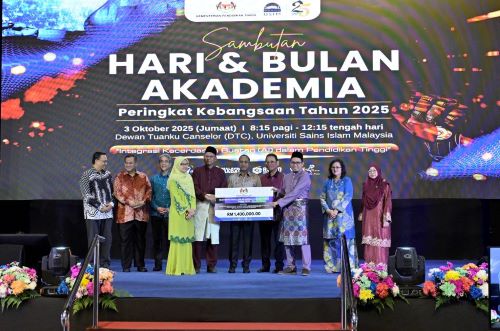
He received the grant presented by the Minister of Higher Education, Yang Berhormat Dato’ Seri Diraja Dr. Zambry Abd Kadir, in conjunction with the National-Level Academia Day and Academia Month 2025 Celebration held at the Dewan Tuanku Canselor (DTC), Universiti Sains Islam Malaysia (USIM).
By: Nur Hartini Mohd Hatta, Centre for Corporate Communications
Translation by: Dr. Rozaimi Abu Samah, UMPSA Press
- 143 views
 Reports by: