
UMPSA researchers develop RimauStrike to enhance sepak takraw training effectiveness
PEKAN, 11 March 2026 – Conventionally, the current commonly used training method involves the coach striking the sepak takraw ball using a tennis racket to simulate actual match situations; however, this method has several limitations, as the speed, direction, and trajectory of the ball often become inconsistent.
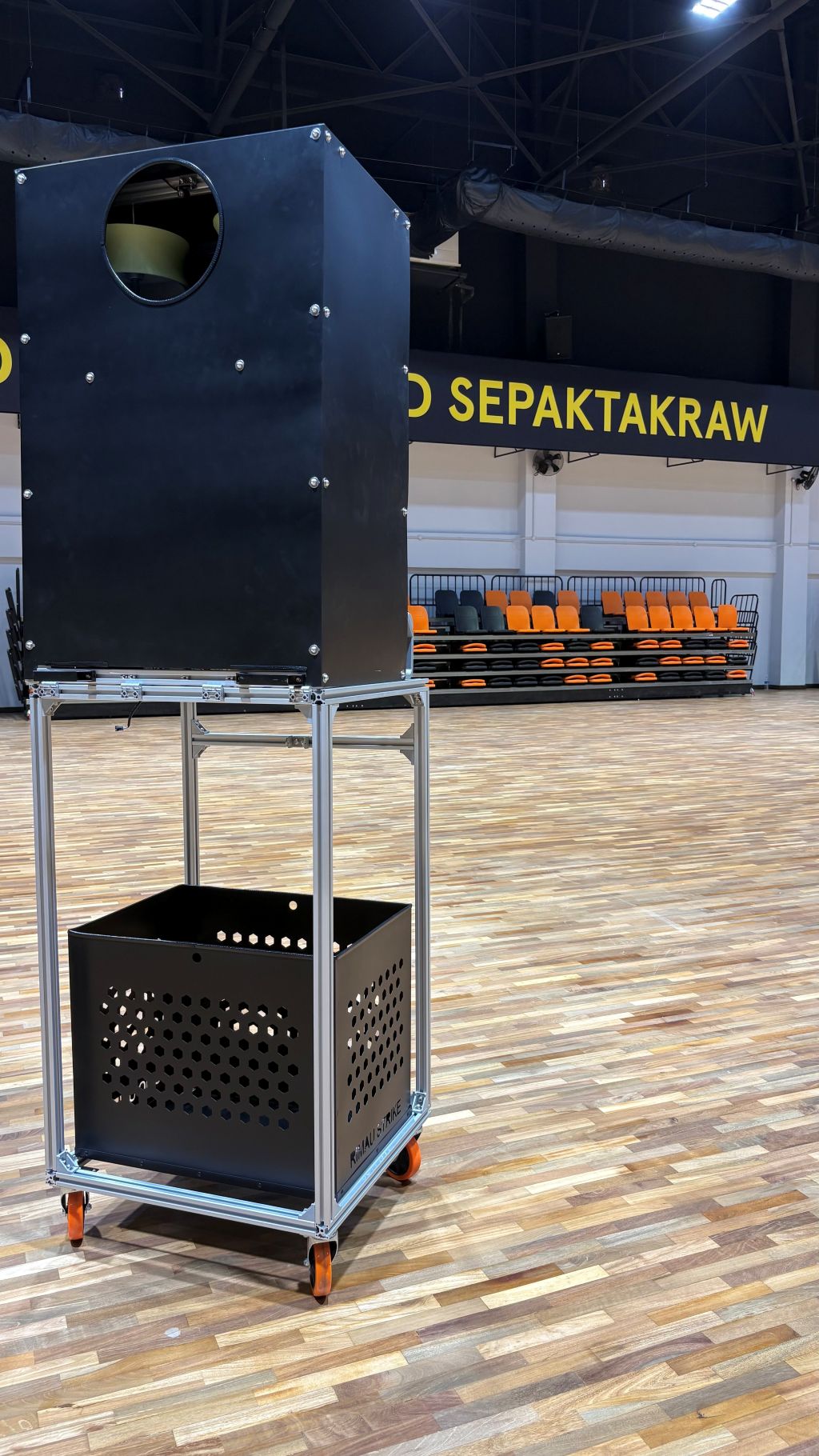
In view of these limitations, researchers from the Faculty of Mechanical and Automotive Engineering Technology (FTKMA), Universiti Malaysia Pahang Al-Sultan Abdullah (UMPSA), Ts. Idris Mat Sahat, Ts. Dr. Mohd Faizal Sadali, and Associate Professor Ts. Dr. Mohd Hasnun Arif Hassan, who is also the Director of the Sports Technology Innovation Centre (STIC) UMPSA, have developed a sepak takraw ball launching machine named RimauStrike, a sports technology innovation designed to improve the effectiveness and consistency of athletes’ training sessions.
This research was carried out by UMPSA researchers through STIC UMPSA, which is the National Sports Industry Centre of Excellence.
According to Associate Professor Ts. Dr. Mohd Hasnun, conventional training methods can become inconsistent due to factors such as coach fatigue, variations in striking force, and uneven striking techniques.
“Therefore, RimauStrike was developed to provide a training system that is more consistent, repeatable, and controllable.
“This machine is capable of launching sepak takraw balls at adjustable speeds and producing more stable ball deliveries compared to the manual method.
“This research began in 2023 to support biomechanical experiments that require precise and consistent control of ball velocity so that research outcomes can be carried out more systematically, accurately, and repeatedly,” he said.
He added that the initial development of this machine was aimed at producing a prototype sepak takraw ball launcher for research experiments related to the impact of heading the ball on players’ heads.
“In biomechanical impact studies, ball speed must be well controlled to ensure more accurate and reliable experimental results.
“Therefore, we developed a ball launching machine capable of producing a consistent ball velocity that can be adjusted according to laboratory experimental requirements.
“The results of this initial prototype development later opened up the potential for the use of this technology in sepak takraw athlete training,” he said.
The initial prototype also attracted media attention when the innovation was featured by Radio Televisyen Malaysia (RTM) in the programme Game Changer, a programme that highlights local sports technology innovations.
This innovation was featured as one of the efforts by local researchers in developing technology to enhance research and training in the sport of sepak takraw.
He further explained that they improved the prototype by developing RimauStrike as a sepak takraw ball launching machine capable of providing a training system that is more consistent, repeatable, and controllable.
“This machine is designed to assist coaches in conducting training more systematically and to enable players to practise receiving the ball from the tekong at various speed levels and delivery sharpness.
“In terms of its operating mechanism, RimauStrike uses a combination of an automatic ball feeding system and a high-speed rotating wheel mechanism.
“The sepak takraw balls are first stored in the ball storage compartment at the bottom of the machine,” he explained.
According to him, the ball feeding system uses a spiral concept that functions to move the balls gradually from the storage section to the launching section.
“This spiral mechanism ensures that the balls can be delivered continuously and systematically to the upper section of the machine, and when the balls reach the launching section, they pass through two high-speed rotating wheels driven by electric motors.
“The frictional force from the wheel rotation accelerates the balls before they are launched out of the machine at a specific speed.
“This launch speed can be adjusted through an electronic control system, allowing coaches or users to set different speed levels according to the training requirements of the athletes,” he said.
In addition, the use of this machine allows players to practise receiving balls from the tekong more consistently and repeatedly, thereby helping to improve ball control skills, reflexes, and players’ readiness in facing actual match situations.
Meanwhile, he said that the development and testing of this machine also involved strategic collaboration with the Sepaktakraw Association of Malaysia (PSM) and the Pahang Sports Council (MSP).
“This collaboration is important in obtaining feedback from stakeholders involved in the development of sepak takraw, particularly in terms of athletes’ training needs and the suitability of the use of technology in actual training.
“The Sepaktakraw Association of Malaysia has also provided support in the form of funding for the development of the latest version of the RimauStrike prototype, thus helping to enhance the design and performance of the machine so that it is more suitable for use in athlete training.
“The Pahang Sports Council has also provided support in terms of the use of this technology in the context of state athlete training, as well as feedback related to actual training needs in the sport,” he said.
He explained that, in terms of development cost, one unit of the RimauStrike machine is estimated to be worth around RM25,000, covering raw materials, fabrication processes, prototype development, and the technical services involved in designing and building the machine.
“This cost takes into account the design, testing, and improvement processes to ensure that the machine functions well and is suitable for use in sepak takraw athlete training.
“However, this cost has the potential to be reduced if the machine is produced on a larger scale through commercialisation in the future,” he said.
He added that, to expand the functions of this technology, the research team plans to add several new features in the future.
“These include ball launch direction control, speed and ball spin variations, a mobile application-based control system, as well as the integration of an athlete training data analysis system.
“These improvements are expected to make RimauStrike a more comprehensive smart training system for sepak takraw,” he said.
Apart from the development of RimauStrike, the research team has also produced several other innovations in the field of sepak takraw sports technology.
Among them is Spike Trainer, a training tool designed to help athletes improve their striking skills through more repetitive and systematic training.
The research team has also developed ProB, a special bandana designed for sepak takraw players to help reduce the risk of injury caused by the impact of heading the sepak takraw ball on players’ heads, based on studies related to the biomechanics of ball impact on the head.
They hope that local sports technology innovations such as RimauStrike can be utilised by sports institutions, schools, universities, and sports associations to improve the quality of sepak takraw athlete training.
In the long term, this technology also has the potential to be commercialised as a local sports technology product capable of supporting the development of the sports industry in Malaysia, while strengthening the performance of national sepak takraw athletes at the international level.
By: Nur Hartini Mohd Hatta, Centre For Corporate Communications
Translation by: Ts. Dr. Rozaimi Abu Samah, UMPSA Press
- 34 views
 Reports by: