
How TVET is Reshaping Malaysia’s Economic Future
Once viewed as a secondary option to a university degree, Technical and Vocational Education and Training (TVET) is rapidly becoming the cornerstone of Malaysia’s economic strategy. Backed by substantial government investment, ambitious national policies, and soaring enrolment, TVET is being strategically positioned as a primary engine for building a high-skilled, future-ready workforce. As the nation charts its course towards 2030, this vocational revolution is not just about creating jobs; it’s about forging a new generation of innovators and industry leaders.
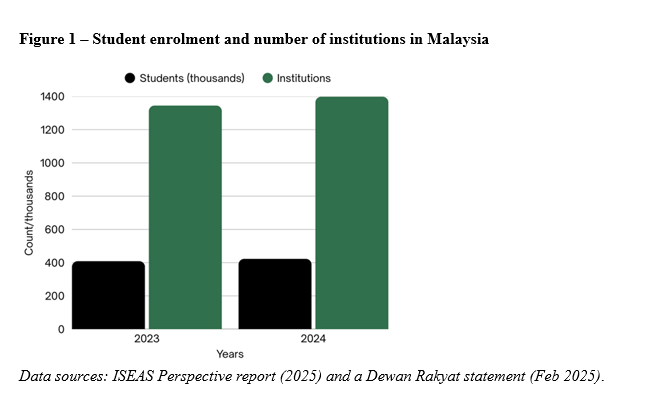
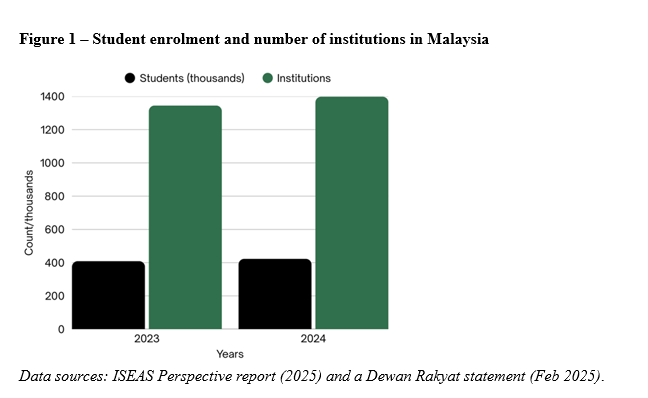
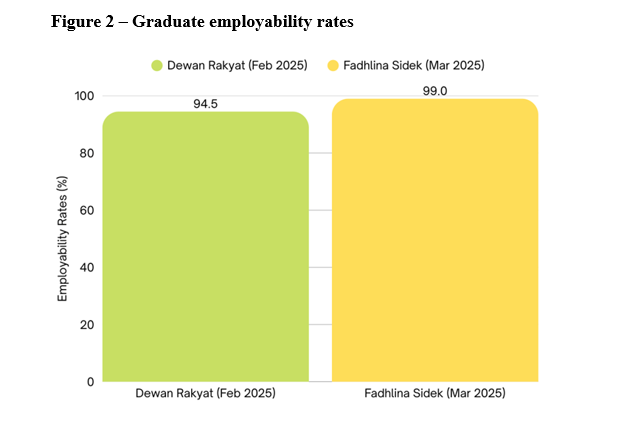
The momentum behind TVET is undeniable. A suite of strategic initiatives, including the MADANI Economic Framework, the New Industrial Master Plan 2030, and the National TVET Policy 2030, has firmly placed vocational training at the heart of national development. The results are already tangible, with student enrolment rising from approximately 408,767 in 2023 to 423,267 across 1,398 institutions in 2024, as illustrated in Figure 1. This surge, as noted by Deputy Prime Minister Ahmad Zahid Hamidi, reflects a significant shift in public perception. More importantly, it is delivering exceptional outcomes. As shown in Figure 2, the government reports a graduate employability rate of between 94.5% and 99%, with Education Minister Fadhlina Sidek highlighting that many students secure job offers even before completing their studies. This phenomenal success rate underscores the labour market’s powerful demand for practical, hands-on skills.
Unprecedented Government Backing
The Malaysian government is putting its full weight behind this transformation. In June 2025, Prime Minister Anwar Ibrahim announced plans to consider a dedicated TVET Commission, a move designed to centralise and accelerate the sector’s development. This followed an injection of an additional RM40 million for the National TVET Council and RM10 million for entrepreneurship programmes in Melaka. Perhaps the most impactful proposal is the call to raise entry-level salaries for TVET graduates from the minimum wage to around RM3,000. It is a clear signal that the government values technical skills on par with academic qualifications and aims to make TVET a financially attractive career path. The 13th Malaysia Plan (13MP), tabled in July 2025, further cements this commitment, aiming to create 700,000 manufacturing jobs and 500,000 digital-economy jobs by 2030, supported by new TVET financing schemes.
Aligning with Industry 4.0 and Global Standards
At the core of the reform is a push to make curricula demand-driven and aligned with high-growth, high-value (HGHV) industries. The focus is squarely on the future: advanced manufacturing, electric vehicles (EVs), semiconductors, renewable energy, and the digital economy. Curricula are being modernised to adhere to Occupational/Industry Standard Practice (OISP) and integrate cutting-edge technologies like artificial intelligence (AI), the Internet of Things (IoT), and augmented reality. Malaysia is also looking outward, positioning itself as a regional TVET hub. It has deepened ties with international partners, sending students to China for specialised training under the Belia Mahir programme and seeking collaboration with UK institutions to strengthen certification in strategic sectors. By hosting the ASEAN TVET Council’s regional policy dialogue, Malaysia is not only showcasing its progress but also leading the conversation on how vocational skills can drive sustainable growth across Southeast Asia.
Navigating the Hurdles Ahead
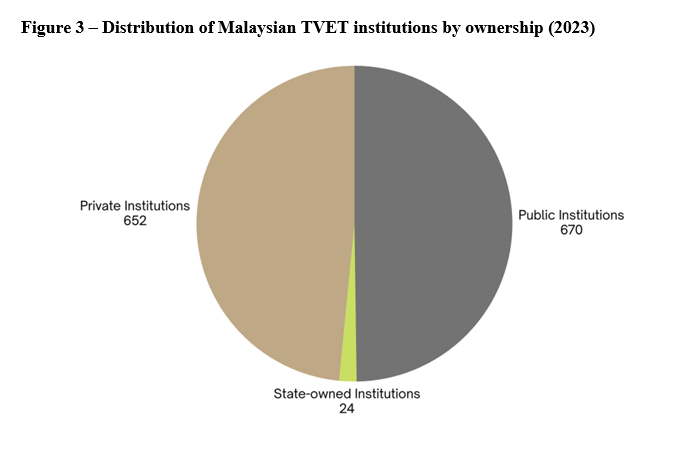
Despite the impressive progress, significant structural challenges remain. A 2025 analysis by the ISEAS-Yusof Ishak Institute points to a fragmented governance model as a key obstacle. With 12 different ministries overseeing public TVET institutions, the system has historically been plagued by “turf wars” leading to parallel systems and a supply-driven focus on enrolment numbers rather than precise industry needs. The distribution of institutions, detailed in Figure 3, highlights this complex landscape, with a mix of federal, state, and private providers making up the ecosystem.
To truly unleash TVET’s potential, experts argue that Malaysia must differentiate vocational institutions from academic universities, centralise governance under a strengthened national body, and fully pivot to a demand-driven planning model. Overcoming the lingering societal perception of TVET as a ‘second-choice’ path remains a crucial part of this transformation. The road ahead requires dismantling old silos and building a truly unified, responsive, and prestigious vocational education system. However, with unprecedented political will, rising public interest, and a clear vision outlined in its national master plans, Malaysia is well on its way to turning its TVET ambitions into a powerful economic reality. The nation’s big bet on skills is not just a policy; it is a promise of a more prosperous and resilient future.

By: Professor Ts. Ir. Dr. Wan Sharuzi Wan Harun
E-mail: sharuzi@umpsa.edu.my
Writer is a Principal Research Fellow, Automotive Engineering Centre, Universiti Malaysia Pahang Al-Sultan Abdullah (UMPSA).
- 940 views