

UMPSA researcher, Dr Mohd Nadzeri produces My-Moove data-driven golf training device
PEKAN, 1 December 2025 – There is an urgent need in the national sports ecosystem, which still relies on subjective training methods without the support of precise and affordable technology.
Most developed countries have adopted data-driven technology as the foundation of athlete development; however, Malaysia still faces limitations in access to quality sports technology, especially at the grassroots level.
Realising this deficiency, Lecturer of the Faculty of Mechanical and Automotive Engineering Technology (FTKMA), Universiti Malaysia Pahang Al-Sultan Abdullah (UMPSA), and also one of the principal fellows at the Sports Technology Innovation Centre (STIC), UMPSA’s new research centre, Dr Mohd Nadzeri Omar, 37, viewed this matter as a gap that not only affects training effectiveness, but also limits the potential of athletes to achieve optimal performance.
He took the initiative to develop My-Moove as a local solution that enables the training process to be strengthened with real, accurate data that is easy to use by athletes and coaches at all levels.
Recently, My-Moove was crowned overall champion and won the gold medal in the 2025 USM-AUSC International Sports Innovation Challenge (SIC), which took place from 21 to 23 November 2025 at Setia Spice Arena, Penang, under the professional category, bringing home a cash prize of RM3,500.
Dr Mohd Nadzeri explained that My-Moove is a Data-Driven Golf Swing Trainer, a motion analysis device that is capable of recording, tracking, and analysing the biomechanics of golfers in detail, thus opening a new chapter in technology-based athlete development in Malaysia.
“The idea to produce My-Moove emerged when observing the national athlete training ecosystem that still depends on subjective methods, and the excellence of today’s athletes no longer depends solely on talent and training alone, instead requiring technological support that can provide accurate data to optimise athlete performance.
“We see how sports-developed countries, particularly in golf, use technology extensively in the athlete development process.
“However, in Malaysia, access to high-performance sports technology is still limited, expensive, and not user-friendly, making the data-driven training process difficult,” he said.
He added that this research began in 2022 through his student’s final year project, Atiqullah Huzaifah, before being continued to the master’s level.
“Within three years, various prototype versions were produced, tested, and improved on-site, involving industry collaboration, which further strengthened this product’s development, among them the active involvement of Zuazizi Aziz from Al-Julf Golf Club Fitter, who provided direct industry insights.
“FTKMA lecturers, Associate Professor Dr Hasnun Arif Hassan and Dr Nasrul Hadi Johari, also contributed technical expertise in ensuring system accuracy and stability.
“The existence of STIC was also very helpful as a supporting ecosystem in the development and progress of this product,” he said.
Sharing about My-Moove, at the early stage, he purchased a commercial IMU device to study golfers’ movements, but found that it had many limitations, and these weaknesses became the motivation to produce a more stable, affordable, and internationally comparable local product.
“The device’s communication system using Bluetooth was unstable and made data recording difficult, especially when involving multiple sensors simultaneously.
“In addition, to measure golf swing movements specifically, researchers needed to be very close to the player, which not only posed an injury risk but could disrupt the athlete’s focus, thereby affecting data accuracy.
“Most other devices are also expensive and can only measure a single movement point,” he explained.
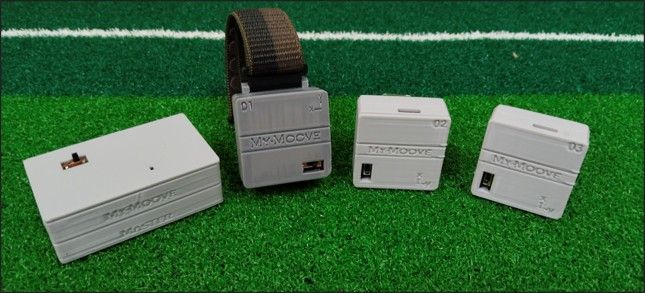
According to him, My-Moove enters the market as a system comprising sensors, a receiver, a user interface via a web server, and analysis software.
“Sensors are installed on body parts such as the waist, hands, or shoulders to record each movement in real time, before the data is transmitted to the receiver via stable wireless communication.
“The receiver then transfers the data to the web server, enabling users to control recordings, view sensor status, and download data easily.
“The analysis software processes the data into graphs and movement profiles to assist athletes or coaches in identifying strengths and weaknesses of swing techniques,” he said.
He added that My-Moove comes in two modes, namely single-unit for single body-part analysis and multi-unit for measuring coordination of several body parts required to understand the complexity of golf swing movements.
“Although developed using modern technology, My-Moove is offered at a lower price compared to foreign products, where the multi-unit package containing three sensors is offered at RM399, while the single-unit is only RM250.
“In the global market, products with more limited functions usually start at RM600 and only support one measurement point.
“This affordable pricing approach aims to ensure that sports technology is not only confined to elite athletes, but can also be enjoyed at the grassroots level,” he said.
Dr Nadzeri also explained that the main objective of this research is not merely to produce a product, but to change Malaysia’s sports training culture towards a technology- and data-based approach.
In May 2025, one unit of My-Moove was handed over to the Pahang Sports Council (MSP) for use in the training and development of state athletes.
At the same time, Dr Nadzeri recently received the UMPSA Social Innovation Grant worth RM20,000 specifically to produce more My-Moove units to be distributed to MSP satellite training centres throughout Pahang.
“We believe that the use of technology such as My-Moove can enhance training effectiveness, help coaches make objective assessments, and enable athletes to understand their techniques more deeply.
“We also hope that this effort can contribute to building a strong local sports technology ecosystem, thereby reducing dependence on expensive imported products.
“My-Moove is only the first step in a long journey towards making Malaysia a respected producer and user of sports technology,” he said.
He hopes that more athletes, coaches, and sports organisations can benefit from this technology to improve performance and subsequently place Malaysia at a higher position in the international sports arena.
He said that My-Moove is only the initial effort.
“We, together with STIC, will continue to produce sports technologies that are not only affordable and low-cost but also of high quality so that they can be utilised by all levels of society and make Malaysia a great power in sports,” he said.
Besides My-Moove, Dr Nadzeri has also developed several advanced products, such as My-Skell, which uses human-pose tracking technology to analyse movement visually.
My-Sense is a wearable device that provides vibration alerts when movement exceeds the set range and Goalkeeper Agility Trainer to evaluate goalkeeper reflexes.
These products, all of which are data-driven, demonstrate Dr Nadzeri’s commitment to continuous research to expand sports technology in Malaysia.
Apart from USM-AUSC International SIC 2025, My-Moove has also received many recognitions throughout its development, including the silver medal at the Creation, Innovation, Technology and Research Exposition (CITREX) 2023, finalist of the Malaysia Sports Technology Innovation Award 2024, and the gold medal at CITREX 2025.
By: Nur Hartini Mohd Hatta, Centre for Corporate Communications
Translation by: Ts. Dr. Rozaimi Abu Samah, UMPSA Press
- 117 views
 Reports by: