
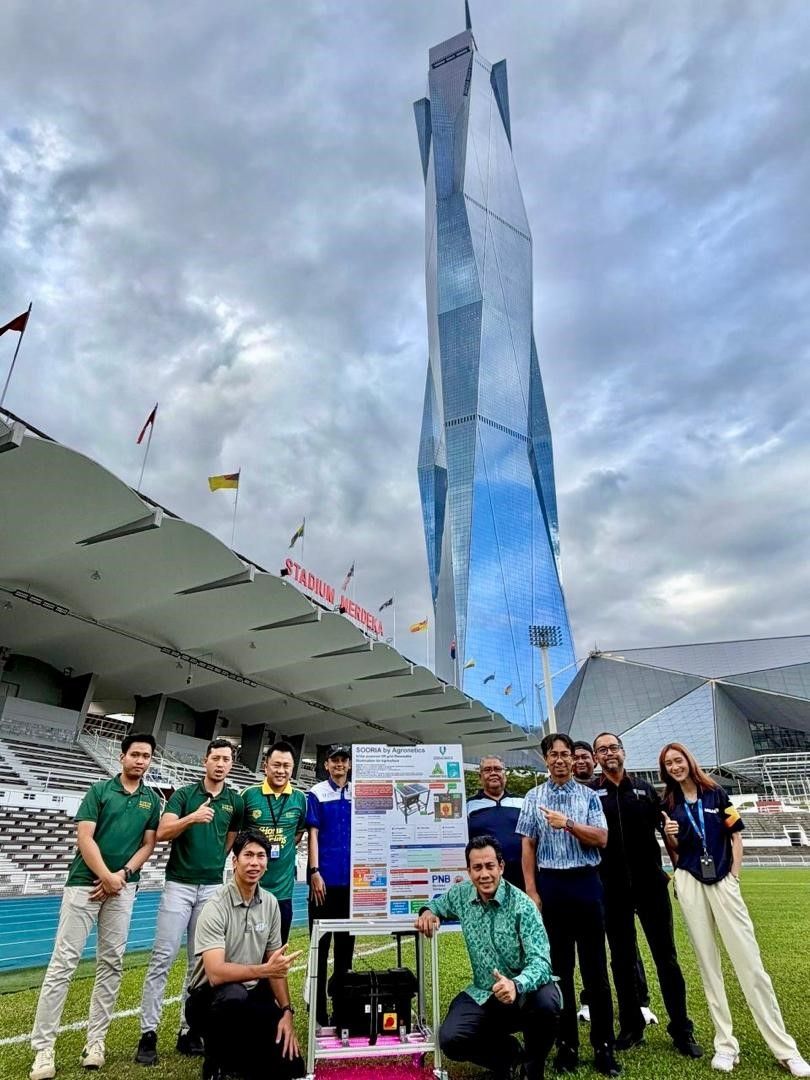
UMPSA researcher develops solar-powered LED Grow Light innovation to support turf quality at Stadium Merdeka
KUALA LUMPUR, 15 January 2029 – The need to maintain consistent stadium turf quality has become the driving force behind the development of a green technology-based innovation by a lecturer from the Faculty of Manufacturing and Mechatronic Engineering Technology (FTKPM), Universiti Malaysia Pahang Al-Sultan Abdullah (UMPSA), Dr. Mohd Azraai Mohd Razman.
The research also involves collaboration with a lecturer from the Faculty of Mechanical and Automotive Engineering Technology (FTKMA), Associate Professor Ts. Dr. Mohd Hasnun Arif Hassan, who is also President of the Malaysian Sports Technology Association (MySTA) and Director of the Sports Technology Innovation Centre (STIC) UMPSA, a lecturer from FTKPM, Dr. Muhammad Amirul Abdullah, as well as UMPSA postgraduate students Amir Fakarulisroq Abdul Azak, Muhammad Nur Aiman Shapiee, Nur Aliya Syahirah Badrol Hisam, and Ahmad Alif Farhan Ahmad Razlan.
According to Dr. Mohd Azraai, the study began in 2025 when the management of Stadium Merdeka expressed real challenges faced in turf maintenance, particularly uneven grass growth due to insufficient natural sunlight in certain areas of the field shaded by structural elements, which in turn affected overall turf health, density, and quality.
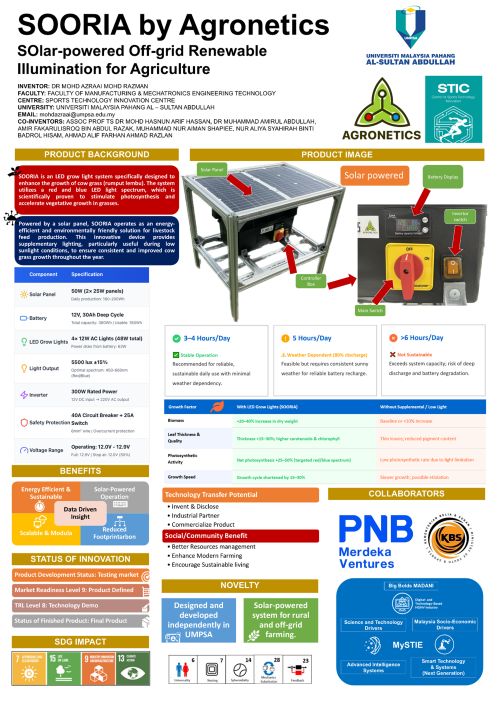
“Recognising the importance of pitch surface quality for player safety, sports performance, and the professional image of a national-level facility, a solar-powered LED Grow Light system known as SOORIA was developed to provide sustainable, energy-efficient, and practical supplementary lighting for use in stadium environments.
“SOORIA is capable of supporting and monitoring grass growth consistently and efficiently in terms of energy use.
“It is designed to operate off-grid, using energy generated from solar panels and stored in batteries before being controlled through a controller box and inverter,” he said.
He added that the design enables the system to function without dependence on conventional electricity supply, thereby supporting green and environmentally friendly energy use.
“Through SOORIA, additional artificial lighting is supplied using LED technology to ensure the grass receives sufficient light spectrum and intensity even under low sunlight conditions or unpredictable weather.
“This capability allows photosynthesis to occur continuously, thus supporting more uniform, stable, and high-quality grass growth at all times.
“This research was officially initiated in 2025 and is currently in the testing and data collection phase after the system was installed and utilised at Stadium Merdeka,” he said.
He added that implementation at the actual site allows the system’s effectiveness to be comprehensively evaluated in terms of LED lighting performance, uniformity of grass growth, impact on turf health, and surface density.
“The data obtained serve as the basis for evaluation to ensure that the system meets stadium operational and maintenance requirements.
“The study is still ongoing in collaboration with Stadium Merdeka and PNB Merdeka Ventures.
“Once the data collection phase is completed, the information and findings obtained will be used for system improvements and the development of subsequent versions to further enhance SOORIA’s performance, usability, and reliability,” he said.
In addition, he noted that in terms of operational mechanism, SOORIA is fully powered by solar panels and controlled through a controller box and an inverter, enabling energy-efficient and sustainable operation.
“The LED lighting supplied to the grass helps accelerate growth, strengthen turf structure, and improve surface density and durability.
“The system’s portable and self-powered design also makes it easier for stadium staff to handle and relocate the equipment without the need for cable installation or searching for power sockets.
“The system only needs to be charged using solar energy and left to operate, making it more practical, safe, and suitable for use in open field areas such as sports stadiums,” he said.
He explained that the ultimate goal of this research development is to provide a solar-powered LED Grow Light system capable of ensuring healthier, more uniform, and higher-quality stadium turf growth even under limited natural lighting conditions.
“The findings have the potential to address various issues in the sports turf management industry, particularly uneven grass growth, surface damage, and high maintenance costs due to reliance on manual methods and weather factors.
“With the use of this system, stadium management can maintain turf quality more consistently, enhance player safety, and ensure professionalism and effectiveness in sports facility management.
“In addition, the system supports the sustainability agenda through the use of renewable energy and reduced dependence on conventional energy sources,” he said.
He further explained that in terms of future planning, SOORIA has significant potential for expanded functionality.
“The system can be modified with variations in LED spectrum to meet the needs of other crops and is not limited to grass alone.
“Each type of plant requires different lighting characteristics, and this system can be adjusted to support more optimal growth according to specific applications.
“In addition, the system’s size and design can be developed in larger or more compact forms depending on usage requirements,” he said.
This flexibility allows the system to be adapted for various scales of application, including stadiums, agricultural farms, greenhouses, and landscape areas, thereby enhancing its usability and commercial potential.
In terms of cost, he added that the estimated development cost of the SOORIA prototype is approximately RM5,000, covering main components such as solar panels, batteries, an inverter, a control system, and LED lights.
“This cost reflects the function of the prototype as a testing platform before system improvements and expansion are carried out at the next stage.
“In addition to STIC, the research involves strategic collaboration with PNB Merdeka Ventures and the Ministry of Youth and Sports (KBS), particularly in the context of system application at Stadium Merdeka.
“This collaboration enables the developed technology to be tested and applied in a real environment and to meet the needs of the sports facility management industry,” he said.
As an early recognition of the potential of the developed technology, SOORIA was officially demonstrated before the Chief Executive Officer of PNB Merdeka Ventures, Dato’ Ir. Ts. Izwan Ibrahim, Chairman of PNB Group, YM Raja Tan Sri Dato’ Seri Arshad Raja Tun Uda, and the Stadium Merdeka team, including Roger Ong and Muhammad Haris Zulkifly, as well as several other stakeholders.
SOORIA was also introduced to the Special Officer to the Minister of Youth and Sports, Fadzil Hadri Mohd Nawawi, and the Senior Director of the UMPSA Research Excellence Management Centre, Professor Abdul Adam Abdullah, as part of efforts to showcase the technology’s potential in real stadium pitch applications.
Beyond the development of SOORIA, Dr. Mohd Azraai is also active in various research and development initiatives involving internet of things (IoT), automation, and artificial intelligence in agriculture and sports.
Among the products and systems developed are a smart fertigation system, Agronetics Crop Detection, IoT Greenhouse (SELESAI), and an Auto-Feeder device for aquaculture automation (LUNAS).
In the field of sports technology, he has also developed an athlete performance monitoring system using smart sensors and IoT to help enhance training effectiveness and performance analysis.
All these research initiatives reflect UMPSA’s commitment to leading high-impact technological development that not only supports industry but also delivers continuous benefits to society and the nation.
For further information regarding this research and innovation, please visit agronetics.net.
By: Nur Hartini Mohd Hatta, Centre for Corporate Communications
Translation by: Ts. Dr. Rozaimi Abu Samah, UMPSA Press
- 45 views
 Reports by: