
Malaysia’s ECRL Project: A Marvel in Motion or a Disaster in Waiting?
As Malaysia advances its transportation infrastructure to align with its economic ambitions, the East Coast Rail Link (ECRL) stands as a symbol of progress, a high-speed connection meant to bridge the east and west coasts of Peninsular Malaysia. Set to commence full operations in 2027, the ECRL promises faster logistics, economic integration, and regional upliftment. However, beneath this steel-and-concrete marvel lies a far less glamorous truth: the environmental and geotechnical implications that could spell long-term consequences for the very soil it stands on.
While the economic benefits are widely touted, the engineering and environmental communities are voicing growing concerns about the ECRL’s path through highly sensitive terrain, particularly the collapsible soil zones and residual tropical formations that define much of the East Coast region. Left unmitigated, these geotechnical challenges could trigger not only excessive settlement but also widespread slope failures and infrastructure vulnerability.
Understanding the Terrain: A Fragile Foundation
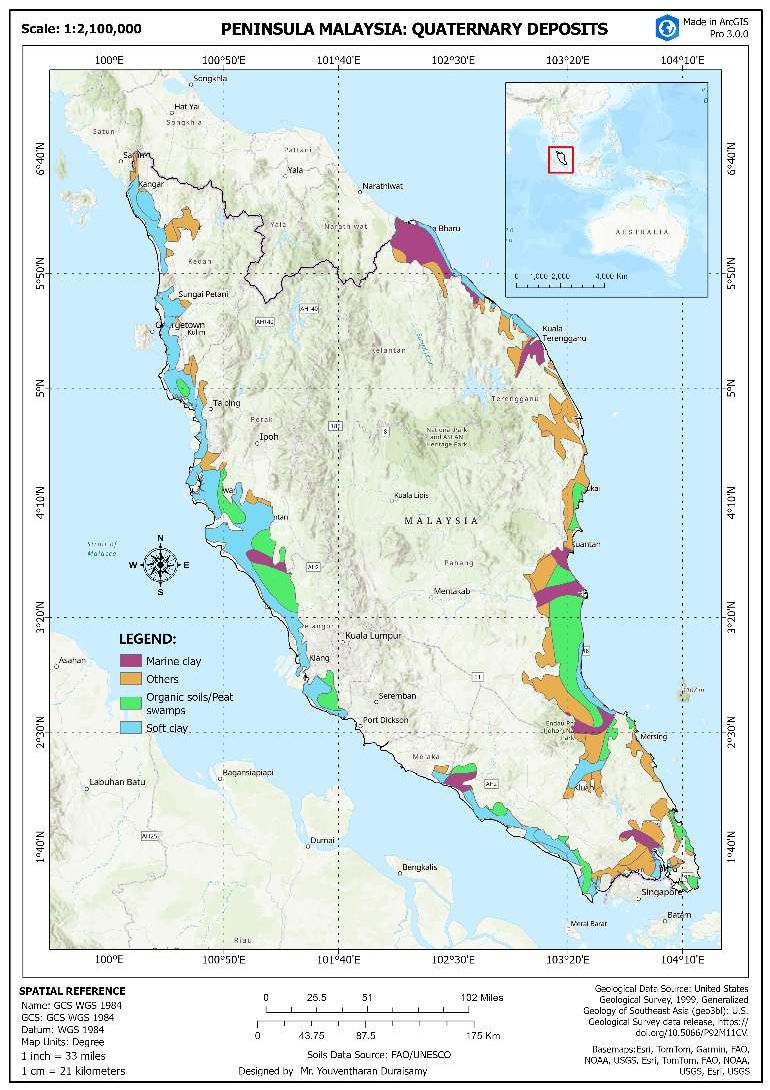
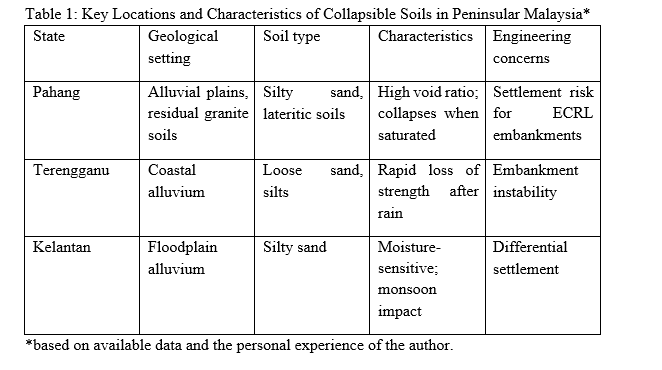
The East Coast is underlain by extensive zones of collapsible soils, which, though stable in their natural dry condition, lose strength dramatically when saturated. When loaded with structural weight such as rail infrastructure and subjected to moisture fluctuations due to monsoon patterns or climate change, these soils are prone to sudden and uneven settlement.
Residual soils, commonly found in the hilly terrains of Terengganu, Kelantan, and Pahang, are also highly variable in strength and prone to slope instability when disturbed by earthworks or deforestation. Rail alignments cutting through such terrain can act as triggers for deep-seated landslides, especially when compounded by improper drainage or unsupervised slope cuts.
Historical Events and their significance
1. Batang Kali Landslide (December 2022):
- A slope failure from the road embankment buried a campsite near Genting Highlands.
- Involved ~450,000 m3 of soil, killing 31 people.
- Triggered by heavy rainfall; reinforced need for slope mapping and maintenance.
2. Genting–Batang Kali & Genting Sempah Roads:
- Historical landslides (1995: 20 deaths, 2014: closure from slope failure).
- Shows embankments over collapsible soils are risky—like those planned for ECRL.
Environmental Disruption Beyond the Rails
The issue is not purely geotechnical. Large-scale transportation projects bring with them an ecological cost, one that includes:
• Clearing of forest reserves, disrupting biodiversity corridors,
• Sediment runoff into rivers, harming aquatic ecosystems and increasing siltation,
• Altered hydrology, increasing flood risks downstream.
In particular, some portions of the ECRL alignment cut through water catchment zones and protected forests, potentially displacing endemic species and threatening Malaysia’s already vulnerable natural heritage. Construction near highlands or karst areas may even open sinkholes or create irreversible changes to groundwater flow.
Are We Engineering with Nature — Or Against It?
Malaysia has the talent and tools to build sustainably. What we lack is often the policy enforcement and early-stage geotechnical integration into mega-project planning. In the case of ECRL, the pressing question is: Have enough soil investigations, slope hazard mapping, and hydrological studies been conducted and, more importantly, acted upon?
Time and again, we have seen the cost of hindsight. The Highland Towers tragedy, the Bukit Kukus landslide, and the recent sinkholes in urban areas, such as the Masjid India incident, remind us that engineering oversight on unstable ground is not merely a design error, but it is a life-threatening gamble.
Engineering Recommendations That Must Not Be Ignored
To avoid the ECRL becoming an environmental time bomb, it is critical that:
1. Detailed Geotechnical Risk Assessment be mandatory along the entire alignment, especially in known collapsible soil areas.
2. Slope Stability Monitoring Systems be installed with real-time alerts during and post-construction.
3. Advanced Ground Improvement Techniques, such as dynamic compaction, soil replacement, or deep soil mixing, be deployed where required.
4. Environmental Impact Assessments (EIA) be continuously updated — not just pre-construction but during operations.
5. Transparent public reporting on environmental mitigation strategies to restore public trust and allow academic scrutiny.
6. Collapsible Soil Map must be produced by the relevant authorities as guidance to local government and town planners to propose any mitigation actions.
Balancing Progress and Responsibility
No one is disputing the potential economic merits of the ECRL. However, responsible engineering must account for not just the structure, but the substrate, the ecosystem, and the communities it affects. Short-term progress cannot come at the cost of long-term environmental degradation and structural failure.
If the government and contractors act now proactively, transparently, and with scientific diligence, the ECRL can still be a beacon of sustainable development. Without serious reconsideration of the geotechnical and ecological concerns, we risk building not a railway of the future, but a costly reminder of what happens when we move too fast and think too little about the ground beneath our feet.

By: Ir. Ts. Dr. Youventharan Duraisamy
E-mail: youventharan@umpsa.edu.my
Ir. Ts. Dr. Youventharan Duraisamy is a senior lecturer in the Faculty of Civil Engineering Technology at Universiti Malaysia Pahang Al-Sultan Abdullah (UMPSA). His expertise lies in tropical soil mechanics and slope stabilisation. He is the founder of the TROPITER app and advocates for the importance of sustainability in construction and building works.
References
Geotechnical & Collapsible Soil References
1. Public Works Department Malaysia (JKR). Guidelines for Slope Design and Construction in Malaysia, 2010–2022 editions.
2. Minerals and Geoscience Department Malaysia (JMG). Engineering Geology Maps of Peninsular Malaysia, Sheets 1–14.
3. Rahman, Z., & Taha, M.R. “Engineering Behaviour of Collapsible Soils in Peninsular Malaysia.” Malaysian Journal of Civil Engineering, 2014.
4. Ibrahim, A. et al. “Geotechnical Characteristics of Alluvial and Collapsible Soils in the East Coast Region.” ResearchGate, 2015–2020.
5. Lim, K.K. “Residual Tropical Soils of Malaysia: Stability, Structure and Engineering Implications.” Universiti Teknologi Malaysia (UTM) Press, 2012.
6. Jamil, H. & Kassim, K.A. “Collapse Potential of Malaysian Sandy Silt Deposits Under Wetting.” International Journal of Geotechnical Engineering, 2017.
7. European Soil Data Centre (ESDAC). “Tropical Residual Soil Distribution (Malaysia Layer).”
8. Geological Society of Malaysia (GSM). Bulletin on Tropical Soil and Rock Engineering, various issues.
Environmental Impact, Ecology & Hydrology References
9. Department of Environment (DOE). Environmental Impact Assessment (EIA) for Major Infrastructure Projects in Malaysia, DOE Portal.
10. FAO & UNEP Reports on Tropical Deforestation (Malaysia Chapters), 2018–2023.
11. Khalid, M., et al. “Sediment Yield and Monsoon-Driven Erosion in Peninsular Malaysia.” Hydrology Research, 2019.
12. World Wildlife Fund (WWF Malaysia). “Peninsular Malaysia Biodiversity Corridor Disruptions.”
Historical Landslides & Infrastructure Failure Records
13. Public Inquiry Report: Batang Kali Landslide (2022) – Ministry of Local Government Development (KPKT), Malaysia.
14. The Straits Times – “Batang Kali Landslide: 31 Dead, 450,000 m³ Slope Failure Confirmed,” 2022.
15. Associated Press (AP News) – “Malaysia Slope Failure Linked to Heavy Rainfall,” 2022.
16. Scoop.my – “Timeline of the Batang Kali Landslide Investigation,” 2022–2023.
17. Genting Highlands & Batang Kali Landslide Records – Compiled summaries on Wikipedia (verified with NST and The Star reporting).
18. Bukit Kukus Landslide (2018) – Penang State Commission of Inquiry Report.
19. Highland Towers Collapse (1993) – Malaysian Official Commission Report.
Climate, Rainfall & Collapse Triggering Factors
20. ResearchGate – “Rainfall Threshold for Landslide Initiation in Peninsular Malaysia,” multiple studies (JKR & UPM-linked).
21. Universiti Putra Malaysia (UPM) – “Landslide Economic Losses and Rainfall Correlations in Malaysia,” 2015–2022.
22. Malaysian Meteorological Department (MetMalaysia) – Monsoon Rainfall Statistics and Climate Impact Reports.
Rail Infrastructure, Slope Risk & Environmental Management
23. Malaysia Rail Link (MRL) – ECRL Environmental Briefing Notes (public release portions).
24. Construction Industry Development Board (CIDB). Geotechnical and Earthwork Best Practice Guidelines, 2016.
25. Institution of Engineers Malaysia (IEM) – Position Papers on Slope Safety & Engineering Risk.
- 497 views
 Reports by: