
AQUAFUN Empowers STEM Education through Smart Water Rocket Telemetry System
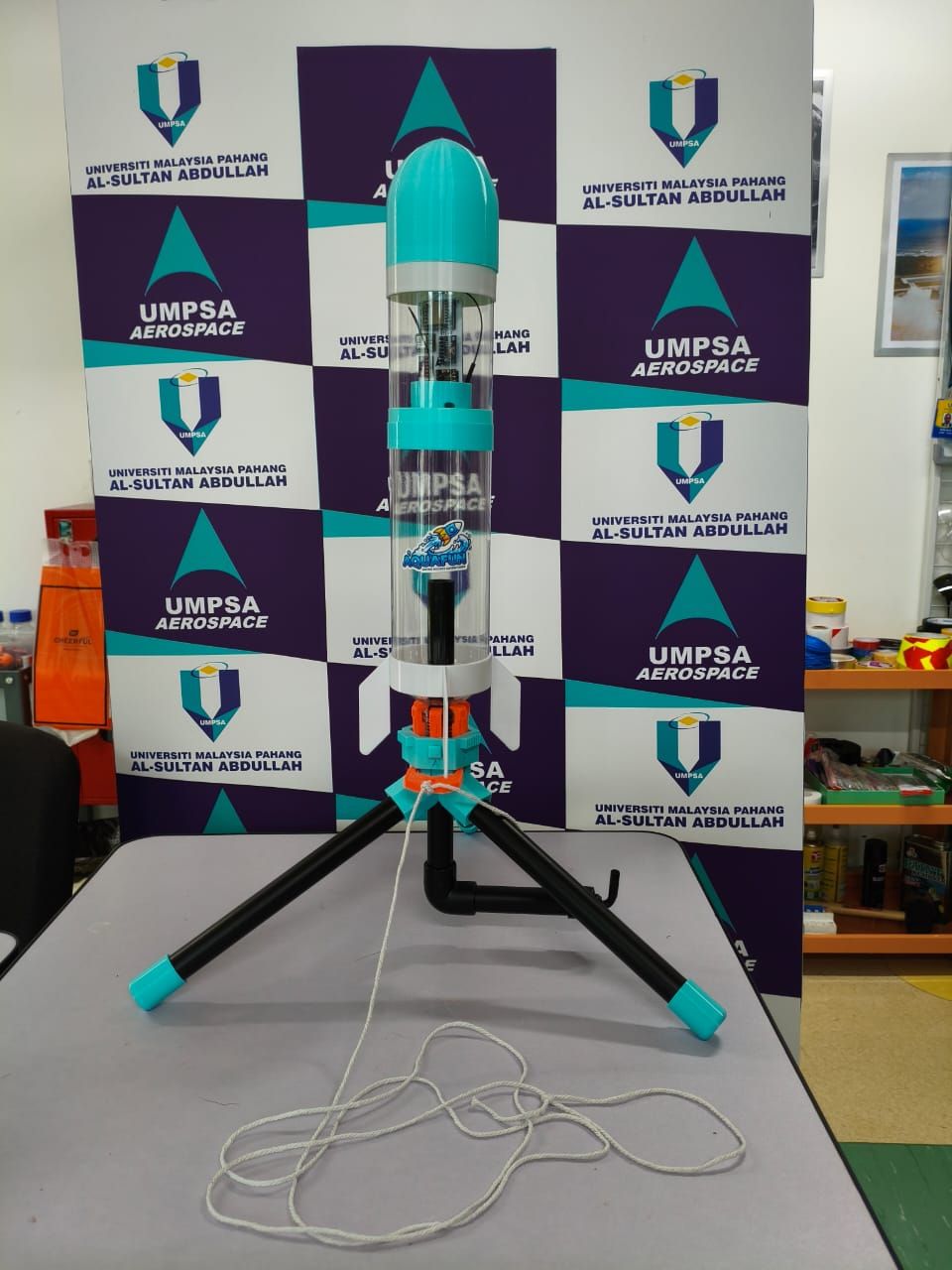
PEKAN, 3 June 2026 – Lecturer and researcher from the Faculty of Computing (FK), Universiti Malaysia Pahang Al-Sultan Abdullah (UMPSA), Dr. Siti Salwani Yaacob, continues to innovate in STEM education through the development of the Water Rocket Launch System with Integrated Telemetry for STEM Education, better known as AQUAFUN.
The innovative product, developed in collaboration with the Center for Advanced Mobility and Aerospace, is designed to help students understand concepts in physics, engineering, and technology more interactively through a hands-on learning approach.
Principal researcher, Dr. Siti Salwani, said AQUAFUN is a water rocket launch system equipped with real-time telemetry technology capable of collecting and transmitting flight data such as pressure, altitude, speed, and acceleration during rocket launches.
“The learning approach using AQUAFUN provides a more enjoyable and effective learning experience as students can see for themselves how scientific theories are applied in real-world situations.
“Through this system, students can not only observe the actual rocket launch but also have the opportunity to analyse real flight data in real time.
“This approach can enhance their understanding of science and technology concepts in a more practical, engaging, and experiential manner,” she said.
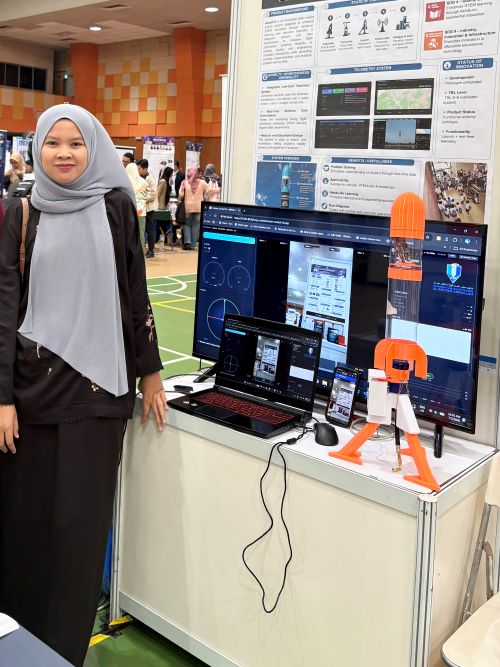
Dr. Siti Salwani, whose expertise includes sensors, data preprocessing, and data analytics, said the idea to develop AQUAFUN arose from the need to make STEM learning more engaging rather than focusing solely on theory.
“Most existing experiments provide limited opportunities for students to conduct direct and in-depth data analysis.
“Therefore, we developed a water rocket system capable of displaying flight data in real time to enhance students’ understanding of science and technology concepts.
“Through this experiment, students can see the relationship between physics theory and its real-world applications in aerospace and modern technology,” she said.
The research, which began in 2025, has now successfully produced a fully functional prototype and reached Technology Readiness Level (TRL) 5 to 6, with the system having been validated and tested in a real-world environment.
The development of AQUAFUN involved collaboration among several researchers, including Ts. Dr. Azlee Zabidi and Ts. Dr. Mohd Izham Mohd Jaya from FK, who focused on developing the telemetry system, including real-time data monitoring, wireless data transmission, and telemetry dashboard integration.
In addition, researchers from the Center for Advanced Mobility and Aerospace, namely Ts. Dr. Muhammad Syahir Amzar Zulkifli, Ahmad Tamimi Ahmad Termizi, and Dr. Erdiwansya, focused on the development and mechanism of the water rocket.
The project was also assisted by FK undergraduate student Nur Aina Izzati Mohammad Azrin under the guidance of the project advisor, Professor Dr. Rizalman Mamat.
According to Dr. Siti Salwani, the AQUAFUN telemetry system operates through several key phases, namely component installation, the launch process, telemetry data transmission, and real-time flight data analysis.
“Sensors installed on the flight platform record important data such as pressure, altitude, speed, and acceleration before transmitting them wirelessly to the monitoring system for visualisation in the form of graphs and real-time analysis.
“Interestingly, the AQUAFUN telemetry system also integrates artificial intelligence (AI) to facilitate smarter and more efficient flight data analysis.
“The AI technology is used to identify data patterns, analyse flight performance, and detect any anomalies or changes occurring during operation,” she said.
She added that although the system was developed using water rockets for STEM education, the telemetry system has significant potential for application in various other technological fields.
“This telemetry system is not only suitable for water rockets but also has the potential to be applied to drones, unmanned aerial vehicles (UAVs), and actual research rockets for real-time flight monitoring and data collection,” she said.
At the same time, AQUAFUN can also be utilised in STEM workshops, educational laboratories, and community programmes to increase young people’s interest in science, technology, and aerospace.
The development cost of the system is also considered low and affordable compared with professional telemetry systems because it uses modular components and low-cost sensors, making it suitable for development as a STEM educational kit.
To expand the product’s functions in the future, the research team plans to enhance the system by integrating internet of things (IoT), AI, and a more interactive and user-friendly analytics dashboard.
AQUAFUN also recorded an impressive achievement by winning a gold medal and a Special Award from the Automotive Engineering Center (AEC) at the 16th Creation, Innovation, Technology & Research Exposition (CITREx 2026).
The research team hopes the innovation can be widely utilised in the education sector to increase students’ interest in STEM and inspire more young people to pursue the fields of technology and aerospace.
In addition, they hope AQUAFUN can be commercialised as an interactive learning kit and telemetry technology training platform for widespread use in schools, universities, and STEM centres nationwide.
By: Naqiah Puaad, Centre or Corporate Communications
Translation by: Ts. Dr. Rozaimi Abu Samah, UMPSA Press
- 43 views
 Reports by: