
BIOPRO: UMPSA Researcher Dr. Nazrolnizah’s Biofeedback Protocol boosts performance of AIM Female Entrepreneurs
PEKAN, 1 August 2025 – Many entrepreneurship programmes to date have focused heavily on business development strategies in both theory and practice but have often placed less emphasis on the internal growth of entrepreneurs, such as motivation, emotional resilience, and self-control.
Statistics from Amanah Ikhtiar Malaysia’s (AIM) entrepreneurship workshops nationwide indicate that most entrepreneurship programmes initiatives prioritise business development strategies theoretically and practically, while paying limited attention to improving participants’ personal performance and inner drive.
Recognising this gap, Dr. Nazrolnizah Mohamad Noorzeli, a researcher from the Faculty of Industrial Management (FPI), Universiti Malaysia Pahang Al-Sultan Abdullah (UMPSA), took the initiative to develop an innovative research project aimed at revolutionising entrepreneurial performance enhancement.
Her research focuses on helping participants regulate their breathing, mind, emotions, and heart through HRV (Heart Rate Variability) Biofeedback training, using a specially designed training protocol.
“The challenge with existing entrepreneurship programmes is that they tend to be overly theoretical, without clear strategies or methods to help entrepreneurs make meaningful personal changes.
“Therefore, this research offers an alternative training approach through the development of new protocols that entrepreneurs can use to boost their performance and grow their businesses,” she emphasised.
The study initially began independantly in August 2024 and was completed in May 2025.
While it was initially carried out independently, it later involved several FPI lecturers, namely Dr. Muhammad Abdul Adib Abd Aziz, Dr. Noraine Bahari, Dr. Nurul Ashykin Abd Aziz, Dr. Mazita Mokhtar, and Wan Khairul Anuar Wan Abdul Manan, as well as FPI postgraduate student Koh Yen Yee, in preparation for participation in the Creation, Innovation, Technology and Research Exposition (CITREX) 2025.
The research uses the EmWave device from HeartMath as its primary instrument for HRV data collection and this device measures the heart rate and real-time heart rate variability via a sensor clipped to the participant’s earlobe.
She explained that, “with this tool, individuals can assess their physiological state to better manage stress, build mental and emotional resilience, and enhance performance in various aspects of life.
She added that, “the EmWave system is a unique training technology developed through research on stress, emotions, and performance.
The system can objectively monitor heart rate patterns and measure the individual’s level of physiological coherence.
“This coherence refers to the harmonious interaction between the heart, liver, brain, and nervous system, which is crucial for resilience.
“Training with EmWave helps individuals improve low coherence levels by altering heart rate patterns and heart rate variability (HRV).
“The pulse wave will appear at the start of the training session as an important step to verify the equipment connection,” she said.
She added that during sensor calibration, the pulse wave will be displayed for a few seconds before disappearing.
“Users can monitor this pulse wave at any time through a dedicated function in the software,” she explained.
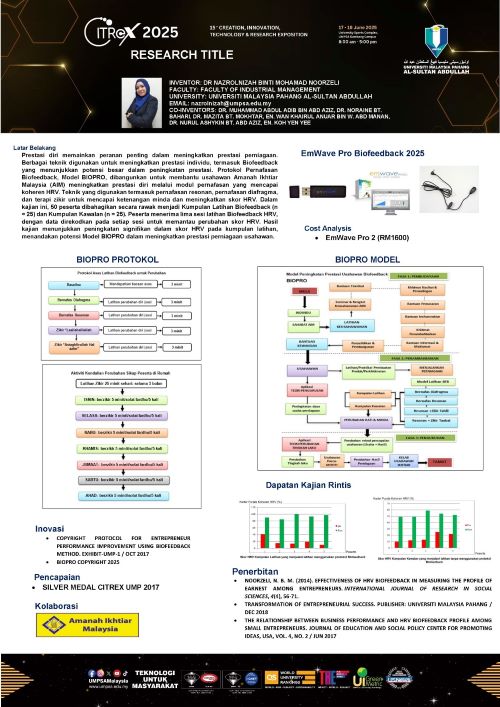
“The BIOPRO protocol consists of five training sessions focusing on different breathing techniques, including diaphragmatic and resonant breathing, combined with dhikr practices such as Tahlil and Taubat.
“Each session lasts three minutes, and the full training takes about 15 minutes per participant,” she said.
Outside formal sessions, participants are encouraged to continue self-transformation activities at home.
“This includes resonant breathing exercises and daily dhikr after obligatory prayers for a period of three months.
“This approach aims to foster inner peace and sustained motivation throughout the daily life.
“The BIOPRO model is structured into three phases which is The Acculturation Phase, The Improvement Phase, and The Reinforcement Phase,” she said.
According to Dr. Nazrolnizah, The Acculturation Phase involves an introduction to entrepreneurship theory, which is usually conducted by AIM before financial assistance is provided.
“The Improvement Phase involves HRV Biofeedback training using the developed protocol, which is the most important phase in helping participants achieve significant changes in their personal performance.
“The Reinforcement Phase focuses on improving business performance and applying behavioural change theories that are relevant for entrepreneurs after the completion of the model.
“The study participants were divided into two groups, namely the Training Group and the Control Group,” she said.
Participants in the Training Group underwent HRV Biofeedback training under her guidance, while the Control Group underwent training without any guidance.
“This arrangement aimed to measure the level of physiological performance control and evaluate the differences in achievement between the two groups.
She stated that “the ultimate goal of this research is to help AIM’s women entrepreneurs strengthen their motivation, make positive personal changes, and succeed in a challenging business environment.
“The research is significant in determining how far Heart Rate Variability (HRV) Biofeedback techniques can enhance personal performance and boost the business success of small entrepreneurs,” she said.
This approach also supports better emotional regulation and overall health through positive physiological changes, achieved by managing HRV and practising proper breathing techniques.
She added that the findings of this study could also benefit government agencies and policymakers in designing more sustainable entrepreneurship programmes. In the long run, such initiatives are expected to uplift the standard of living by nurturing more competitive and highly motivated women entrepreneurs.
“I also aspire to expand this Biofeedback-based programme for Self, Emotional, and Heart Performance Enhancement to a higher level.
“This method is not only relevant to entrepreneurship, but can also be applied in education, the public sector, industries, and any field that requires support in strengthening both internal and external personal performance,” she explained.
Previously, she collaborated with AIM East Zone (Pahang) to conduct the study in Rompin, Pekan, and Kuantan.
For those interested in trying the Biofeedback method, she recommends the EmWave Pro 2 device from HeartMath in the United States, which is currently sold at a price of between RM1,600 and RM2,000 depending on the model and software.
She has been involved in similar research since 2017, when she won a silver medal at CITREX for a project related to Biofeedback.
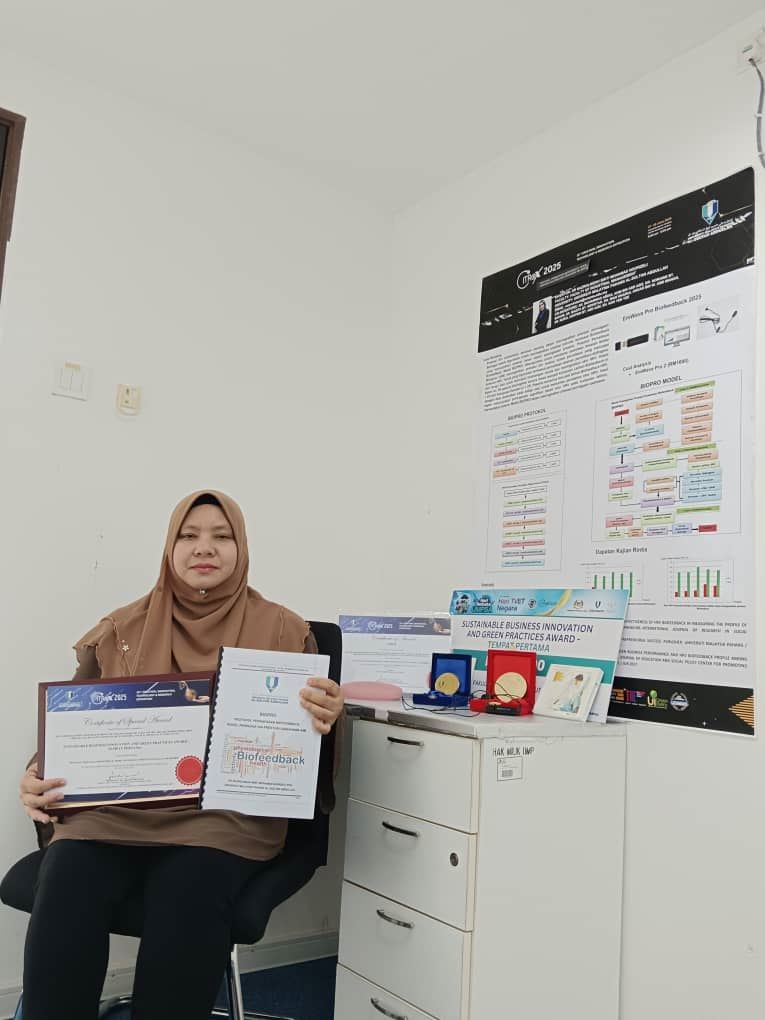
At CITREX 2025, held on 18 and 19 June at UMPSA’s Sports Complex Hall, Gambang Campus, her BIOPRO research earned a gold medal and the Sustainable Business Innovation and Green Practices Award.
The project is also registered as an Intellectual Property (IP) under the name Bio-Usahawan.
In an effort to expand the study for the benefit of society and industry, she plans to launch the Jelajah Biofeedback Malaysia series, which will serve as a training and consultation platform for various organisations which will guide participants in using the modules, protocols, and models developed in the research.
Among the products she has created are the Bio-Usahawan, Bio Module, Bio Protocol, and Bio Model, all of which support the aim of improving personal and business performance through an approach that combines humanities and behavioural science with technology.
By: Nur Hartini Mohd Hatta, Centre for Corporate Communications
Translation by: Aminatul Nor Mohamed Said, UMPSA Career Centre (UMPSACC)
- 79 views