
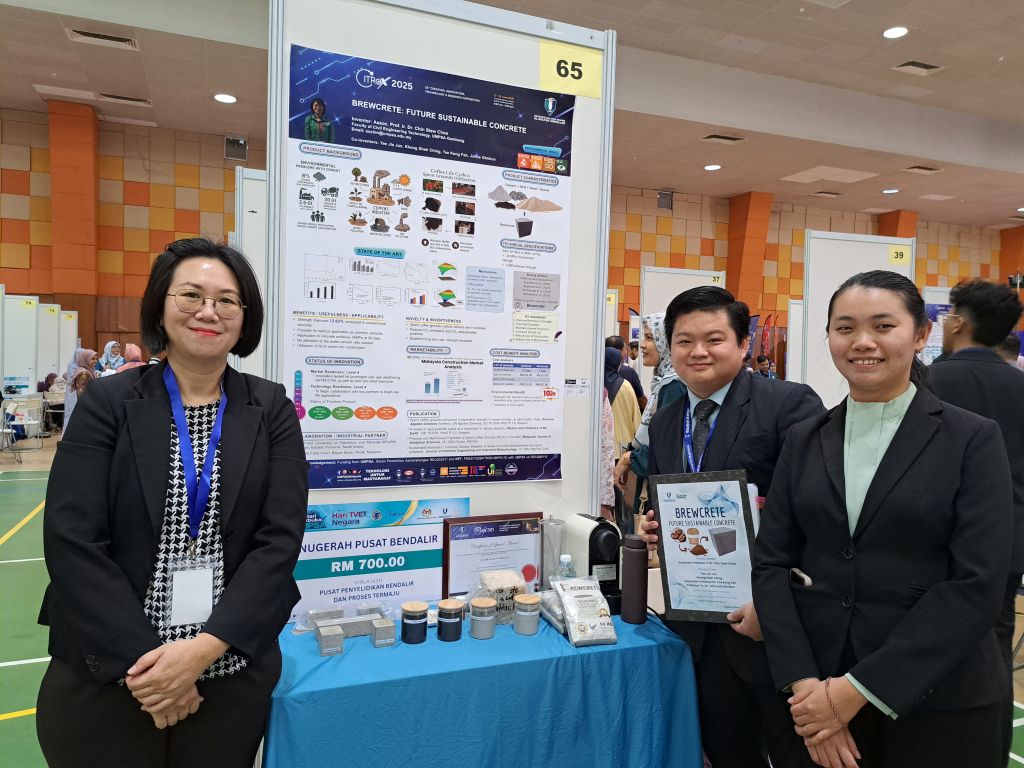
UMPSA researcher Associate Professor Ir. Dr. Chin Siew Choo produces Brewcrete, eco-friendly sustainable cement from coffee waste
PEKAN, 18 August 2025 – Looking at coffee waste, the by-product of the brewing process increasingly produced by Malaysians who drink an average of 2.38 cups of coffee a day (totalling around 3 billion cups daily) and generating about 100 tonnes of coffee waste per day, a team of researchers from Universiti Malaysia Pahang Al-Sultan Abdullah (UMPSA) led by lecturer from the Faculty of Civil Engineering Technology (FTKA), Associate Professor Ir. Dr. Chin Siew Choo, has produced Brewcrete.
This research project examines the use of coffee waste as an additive in concrete cement.
The research, which began in 2020, was the final year project of two FTKA students, Khong Sheh Ching and Yee Jia Jun, who are now postgraduate students.
At that time, they were under the supervision of Associate Professor Ir. Dr. Chin.
Khong shared that she was raised in a modest family.
“My parents worked as coffee brewers at a restaurant in Bagan Serai, Perak, and since childhood, I noticed that a large amount of discarded coffee waste from the shop produced a foul smell after a few hours.
“Although coffee waste is often used as fertiliser, its acidic nature and caffeine content make it less suitable for crops.
“Based on literature review, coffee waste was found to have a composition suitable for concrete production, which sparked the idea of using it as an additive in cement named Brewcrete,” she said.
In addition, the research was assisted by a lecturer from the Faculty of Chemical and Process Engineering Technology (FTKKP), Professor Ts. Dr. Jolius Gimbun, an international collaboration partner, lecturer from the Department of Civil and Environmental Engineering, King Fahd University of Petroleum and Minerals, Saudi Arabia, Associate Professor Dr. Tee Kong Fah.
Moreover, this research received cooperation from Pusat Kedai Makanan Odawala, Bagan Serai, and an FRGS KPT grant (RDU240115 Explicating the Silica and Alumina Reactions from Bamboo, Oil Palm, and Coffee Waste for Use as Sustainable Concrete).
According to Associate Professor Ir. Dr. Chin, if coffee waste is disposed of untreated, it will release methane (~1,280 m3 per day) and thus contribute to global warming.
“Research found that coffee waste has the potential to increase the strength and corrosion resistance of concrete, reduce cement usage, and is capable of capturing carbon dioxide through the hydration reaction of cement.
“Brewcrete also supports Malaysia’s vision of achieving net-zero carbon emissions by 2050 and aligns with the United Nations Sustainable Development Goals (SDG 9, 11, and 13).
“In terms of application, Brewcrete is premixed cement that only requires gravel, sand, and water to produce concrete,” she said.
She added that with processing costs of coffee waste being much lower compared to limestone mining, this product can be marketed at about RM19 per bag, with the potential to become more competitive if produced on a large scale.
“The main objective of this research is to reduce coffee waste, support the net-zero emission goal, and strengthen sustainability values in the construction industry, which now contributes nearly 40 per cent of global CO2 emissions.
“The next plan is to test the durability of Brewcrete in heavy reinforced steel concrete structures.
“We hope the construction industry can accept and use this eco-friendly material for the sustainability of the earth and the nation’s vision of achieving net-zero carbon emissions by 2050,” she explained.
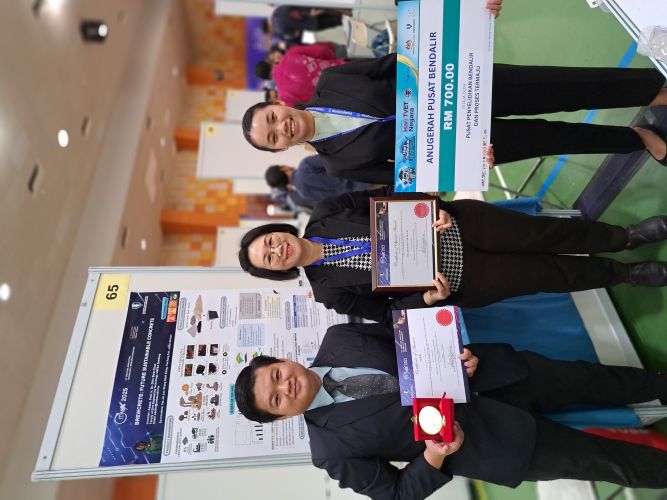
At the Creation, Innovation, Technology and Research Exposition (CITREX) 2025 organised by Universiti Malaysia Pahang Al-Sultan Abdullah (UMPSA) on 18 to 19 June 2025 at the UMPSA Sports Complex Hall, Gambang Campus, this research won a gold medal and the Fluid Centre Award (staff and postgraduate students).
Besides Brewcrete, this team of researchers is also involved in studies on the use of bamboo fibres in concrete and polymer composites for the reinforcement of building structures.
By: Nur Hartini Mohd Hatta, Centre for Corporate Communications
Translation by: Dr Rozaimi Abu Samah, UMPSA Press
- 95 views