
Non-credit Academic Mobility to TJU, China: Chemical Engineering towards future sustainability
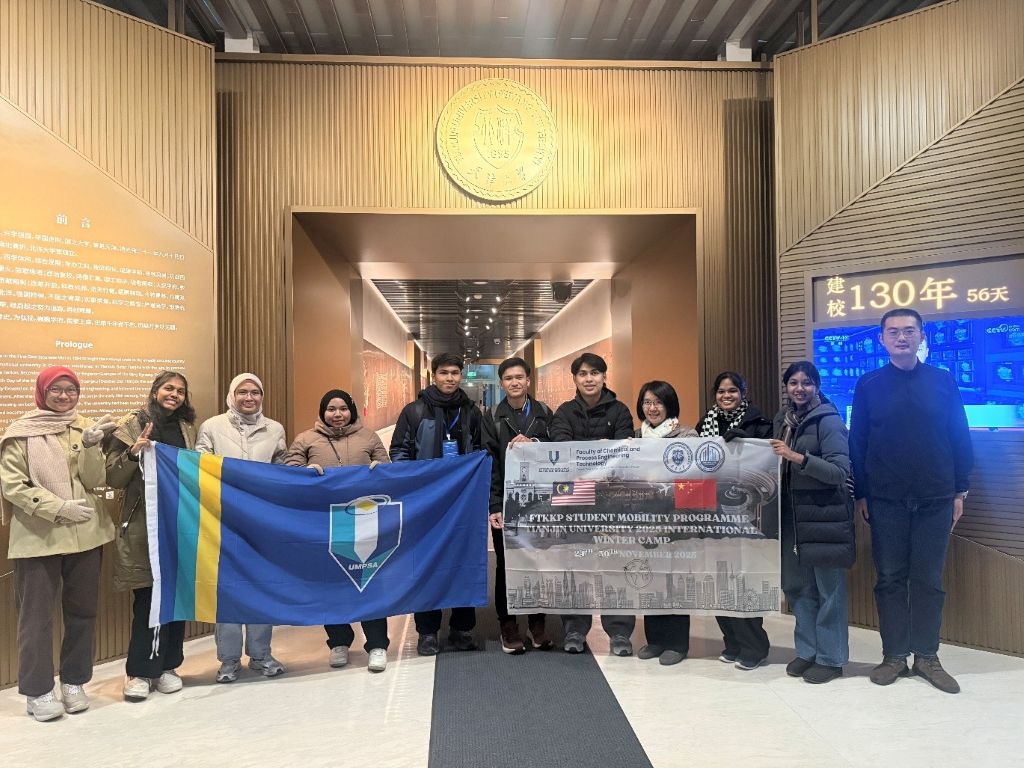
TIANJIN, 30 November 2025 – A total of nine students from Universiti Malaysia Pahang Al-Sultan Abdullah (UMPSA) participated in a non-credit mobility programme to Tianjin University (TJU), China, under the collaboration of the Centre for Academic Collaboration and Mobility, UMPSA, from 24 to 30 November 2025.
The mobility programme titled ‘Tianjin University 2025 International Winter Camp on Chemical Engineering for A Sustainable Future’ was organised by the School of Chemical Engineering and Technology (SCET).
In the opening speech of the programme, UMPSA student representative, Sujita d/o Prem Kumar, shared a Chinese proverb which means ‘learning is like rowing against the current’.
“If one does not move forward, one will move backward.
“This proverb captures the spirit of why we are here, which is to challenge ourselves, move forward and grow beyond the boundaries of existing knowledge,” said Sujita during the opening ceremony.
The intensive week-long visit opened the eyes of the students to a broader world of Chemical Engineering.
The programme began with laboratory safety training delivered by the Director of the Experimental Centre of Chemical Engineering and Technology, Xiangjuan Qi, who emphasised the importance of safety aspects in every research activity.
On the same day, the students also visited the History Museum and the Experimental Teaching Centre, which provided exposure to the history of excellence and expertise of SCET in the field of chemical engineering.
Through sharing sessions with experienced lecturers from SCET, the UMPSA delegation was exposed to the latest developments in various fields of Chemical Engineering.
Professor Dr Yachao Zeng shared the vision of the future of clean energy through his lecture titled ‘Energy & Catalysis Adventure Towards Clean Hydrogen-Powered Future at TJU’, while Associate Professor Dr Daliang Han opened students’ minds on ‘Water Management In Aqueous Zinc Batteries’.
Professor Xinlei Liu then revealed advanced technology through sharing on ‘Network Polymer Membranes for H2 Purification’.
Knowledge sharing continued with Associate Professor Dr Zhenguo Gao, who presented on ‘Crystallization Science and Technology from Scientific Frontier to Engineering Practice’, connecting scientific theory with real industrial applications.
Associate Professor Dr Hong Zhang introduced innovative technology in ‘Polymer Nanofilm Wrapping for Improved Bioimaging’, followed by Professor Dr Ji Qi, who shared on ‘Designing Better Catalysts: The Role of Structure, Support, and Light’.
Practical experience became the backbone of this programme.
The students had the opportunity to visit the Chem-E-Car workshop, where they were involved in interactive question and answer sessions with SCET students, followed by visits to various research centres, including the Experimental Center of Chemical Engineering and Technology, Basic Chemical Engineering Lab, Crystallization Center, and Instrumental Center.
Visits to research laboratories, as well as participation in Experimental Projects 1 and 2, provided opportunities for students to be directly involved in research activities at SCET, which is renowned for world-class research.
Visits to both TJU campuses, namely Peiyangyuan Campus and Weijin Road Campus, also provided a comprehensive perspective on the infrastructure and facilities that support the academic excellence of the university.
In addition to academic content, the programme enriched the cultural experience of the students.
Through a Chinese painting art session guided by Longxiang Fei, students learned bamboo painting techniques that emphasise balance, precision, and the philosophy of harmony with nature.
Meanwhile, the Chinese calligraphy session under the guidance of Liangfeng An provided exposure to the origins of Mandarin words, which are image-based, thereby helping participants understand the relationship between language, symbols, and culture.
Both activities enabled students to appreciate the values of patience, focus, and deep artistic expression within Chinese cultural heritage.
Cultural exploration continued with a visit to Tianjin city, which provided space for students to appreciate the beauty and history of the city.
Through a meaningful closing ceremony, the UMPSA delegation returned with more than just knowledge.
They carried a renewed spirit to continue moving forward in the field of chemical engineering.
This non-credit mobility programme not only provided international-level academic and research exposure to students and enriched cultural experiences, but also helped to strengthen collaborative relationships between both institutions and expand professional networks.
It is hoped that programmes such as this can be continued in the future as a continuous initiative to strengthen the university’s position in the field of chemical engineering at the global level, as well as to provide valuable international exposure to students.
By: Liyana Afiqah Tajul Arifin and Ir. Dr. Chew Few Ne, Faculty of Chemical and Process Engineering Technology (FTKKP)
Translation by: Ts. Dr. Rozaimi Abu Samah, UMPSA Press
- 104 views
 Reports by: